

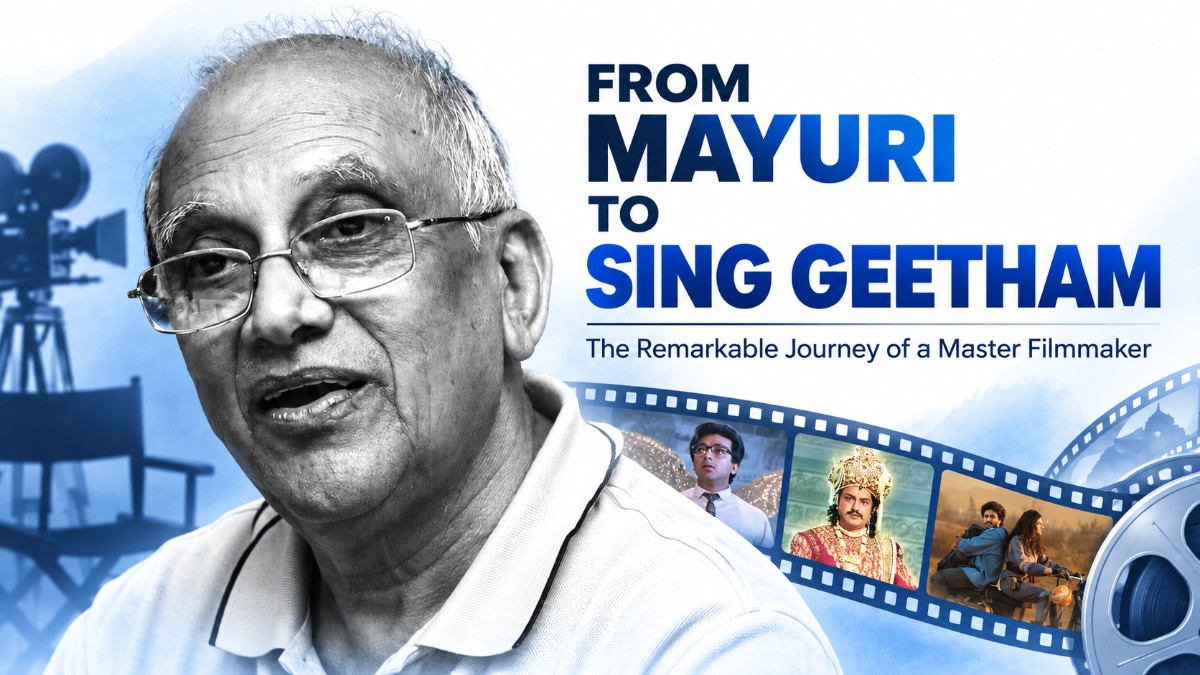
Singeetham Srinivasa Rao turns 95 on September 21, 2026, after a filmmaking career defined by one recurring principle: cinema did not have to obey the form that audiences already knew. Born on September 21, 1931, the director, writer, producer, composer and actor has worked across Telugu, Tamil, Kannada, Hindi and other languages, directing around 60 films before returning with his 61st feature, Sing Geetham, in 2026. His work ranges from social drama and biography to dialogue-free comedy, science fiction, fantasy, visual-effects-driven performance, animation and a musical in which ordinary conversation becomes song.
Calling Singeetham simply a versatile filmmaker does not fully explain his place in Indian cinema. His more distinctive quality is the willingness to remove something audiences consider necessary, then build a complete film around the resulting problem.
What happens when a feature film removes spoken dialogue? Pushpaka Vimana supplied an answer.
Can Telugu commercial cinema build an adventure around time travel? Aditya 369 did it in 1991.
Can an actor of regular height convincingly appear as a much shorter character without the digital tools available today? Apoorva Sagodharargal found practical solutions.
Can the real person behind an extraordinary life story play herself in the film version? Mayuri placed Sudha Chandran at its centre.
Can conversations across an entire feature become songs? At 94, Singeetham returned to directing with Sing Geetham and tried that too.
His career is therefore best understood not as a collection of genres, but as a long series of experiments with what cinema can remove, add, bend or reinterpret.
Quick Facts About Singeetham Srinivasa Rao
Singeetham Srinivasa Rao's career stretches from his apprenticeship under K. V. Reddy during the classical studio era to the release of Sing Geetham in 2026. His filmography connects several generations of Indian filmmaking technology, performers and storytelling styles.
Born: September 21, 1931, in Gudur, in present-day Andhra Pradesh.
Early film training: He worked under filmmaker K. V. Reddy and was associated with films including Mayabazar and Jagadeka Veeruni Katha.
Directorial debut: Neethi Nijayithi in 1972.
Languages: His directing work spans Telugu, Tamil, Kannada, Hindi and other languages.
Major experiments: Mayuri, Pushpaka Vimana, Apoorva Sagodharargal, Aditya 369, Bhairava Dweepam, Little John and Sing Geetham.
National recognition: Dikkatra Parvathi won the National Film Award for Best Feature Film in Tamil, while Pushpaka Vimana won the National Film Award for Best Popular Film Providing Wholesome Entertainment.
2026 return: Sing Geetham, his 61st film, reached theatres in June 2026 with Devi Sri Prasad as music director and Nag Ashwin as producer.
Learning Cinema Under K. V. Reddy Before Becoming a Director
Singeetham Srinivasa Rao's understanding of cinema began inside the working method of K. V. Reddy, one of the major directors of the Telugu studio period. Singeetham joined him in the 1950s and worked on productions that required careful control of story construction, visual effects, staging, performance and production planning. That apprenticeship placed him close to Mayabazar, one of Indian cinema's best-known fantasy films.
According to biographical accounts, Singeetham first met K. V. Reddy in 1954. Reddy reportedly gave the young aspirant a copy of W. W. Jacobs' The Monkey's Paw and asked him to develop a screenplay from it. Singeetham completed the assignment and later became an apprentice and associate director. He worked with Reddy on films from Donga Ramudu through later productions, including Mayabazar, Jagadeka Veeruni Katha and Sri Krishnarjuna Yuddham.
That period matters because Singeetham's later films repeatedly combined imagination with practical filmmaking.
Fantasy was not treated as an excuse to abandon human behaviour. Comedy still needed construction. Effects needed to serve an idea. Spectacle needed clear staging.
When digital filmmaking arrived decades later, Singeetham had already spent years solving unusual visual problems with physical sets, camera placement, performance, editing and design.
His directorial debut, Neethi Nijayithi in 1972, did not immediately make him a commercial force. His next phase showed something that would become common across his career. One result did not lock him into one type of cinema.
Dikkatra Parvathi, adapted from a work associated with C. Rajagopalachari, took him toward a socially grounded Tamil drama. The production was filmed largely in Thorapalli near Hosur and completed in a short shooting schedule. The film later received the National Film Award for Best Feature Film in Tamil.
Singeetham was already moving between commercial storytelling, literary adaptation and formal experimentation before most of the films now associated with his reputation had even been made.
Mayuri Turned a Real Life Story Into Cinema Without Losing the Person at Its Centre
Mayuri demonstrated Singeetham Srinivasa Rao's ability to build a feature around a real person's physical and emotional experience. The Telugu biographical drama tells the story of classical dancer Sudha Chandran, who returned to dance after losing a leg following an accident. Singeetham made the unusual choice of casting Chandran herself as the central character.
The production did not simply reproduce every event exactly as it happened. Screenwriting shaped real incidents into a dramatic structure, while fictional supporting elements helped build the film around Chandran's journey.
That distinction is important. Singeetham's method was not documentary reconstruction. He used commercial cinema techniques to make a personal story understandable to a large audience while keeping the lived experience at its centre.
The result became one of the most recognised films of his career.
Mayuri received 14 Nandi Awards, a figure repeatedly recorded as a record for a Telugu film. Sudha Chandran also received national recognition for her debut performance. The film was shown at the International Film Festival of India and was later remade in Hindi as Naache Mayuri.
The film also reveals a pattern that appears throughout Singeetham's work. The unusual concept is rarely presented by itself. It becomes the mechanism through which an accessible human story is told.
The same principle would become even clearer with his collaboration with Kamal Haasan.
Pushpaka Vimana Proved Spoken Dialogue Was Optional
Pushpaka Vimana remains one of the clearest examples of Singeetham Srinivasa Rao questioning a basic rule of commercial filmmaking. The 1987 film removed conventional spoken dialogue while retaining ambient sound, music, physical comedy, emotion, romance and crime. Its story had to remain understandable through images, actions, expressions, editing and sound design.
Calling Pushpaka Vimana simply a silent film can therefore be misleading. Singeetham himself distinguished between silence and the absence of dialogue. The film contains sound. What disappears is normal verbal conversation.
That creative restriction changed everything else.
The actors had to communicate motives physically. The camera had to provide information that dialogue normally supplies. Objects became more important. Reactions needed precise timing. Editing had to explain relationships and cause-and-effect connections without verbal exposition.
Kamal Haasan's unemployed protagonist, his encounter with wealth and his relationship with the woman played by Amala created a story that could travel across language boundaries because spoken language was no longer required to understand the central action.
The film received the National Film Award for Best Popular Film Providing Wholesome Entertainment. The National Film Award citation recognised its innovative approach to entertainment.
Its importance also lies in Singeetham's reaction to its success.
A filmmaker could easily have converted Pushpaka Vimana into a formula and made more dialogue-free films. Singeetham did not spend the next phase of his career repeating the mechanism.
The experiment had answered its question.
He moved to another one.
That refusal to convert novelty into repetition is one reason his filmography contains so many sharp turns.
Kamal Haasan and Singeetham Built Films Around Performance Problems
The Singeetham Srinivasa Rao and Kamal Haasan partnership produced some of the director's most technically unusual and comically complex films. Their collaborations included Sommokadidhi Sokokadidhi, Raja Paarvai, Pushpaka Vimana, Apoorva Sagodharargal, Michael Madana Kama Rajan, Magalir Mattum, Kaathala Kaathala and Mumbai Xpress.
Each collaboration did not use the same device.
Raja Paarvai centred on a blind violinist.
Pushpaka Vimana removed spoken dialogue.
Apoorva Sagodharargal required Kamal Haasan to appear as Appu, a character with dwarfism.
Michael Madana Kama Rajan multiplied the performance challenge by placing Haasan in four different roles.
The technical methods used for Appu in Apoorva Sagodharargal are especially revealing because modern digital character alteration was not available in its current form.
Different shots required different physical solutions. For some angles, Haasan folded his legs and used specially prepared footwear positioned near his knees. For side views, trenches helped conceal parts of his body. Camera position, body posture, set construction and performance worked together to maintain the illusion. A specialist was also involved in helping the production achieve the required effect.
The effect was not only technical.
Appu needed to work as a complete character rather than as a visual trick. Comedy, anger, vulnerability and revenge all had to survive the illusion.
That division between technique and character is central to understanding Singeetham's films. The filmmaking device attracted attention, but the device was expected to carry drama.
Michael Madana Kama Rajan pushed a different problem. Four separate characters played by the same actor had to occupy a complicated comedy without the audience losing track of personality, identity or action.
Such films required exact staging and editorial control. The complexity had to remain invisible enough for the audience to enjoy the comedy.
Singeetham's interest was therefore not technology for its own sake. He repeatedly used technology, camera tricks, physical production methods and performance design to solve storytelling problems.
Aditya 369 Took Telugu Cinema Into Time Travel in 1991
Aditya 369 made science fiction part of mainstream Telugu entertainment at a time when large-scale Indian genre films rarely centred on time travel. Released in 1991 and starring Nandamuri Balakrishna, the film sends its characters across different periods through a time machine, connecting contemporary life, the era of Krishnadevaraya and a distant future.
The achievement was not simply putting a machine on screen.
Time-travel storytelling requires the audience to understand rules, shifts in time, consequences and different worlds without losing the emotional thread of the film.
Singeetham combined those requirements with comedy, adventure, history and commercial Telugu film conventions.
The section involving Krishnadevaraya allowed the film to move into historical fiction. The future sequences required another design language. The present-day story still had to connect those separate periods.
This is where Singeetham's earlier experience with fantasy and practical production became useful.
Indian science fiction has expanded greatly since 1991, particularly as computer-generated imagery has become more accessible and production budgets have increased. Aditya 369 came from a different production environment.
Its reputation therefore rests partly on timing. The film treated time travel not as a small side idea but as the structural engine of a mainstream Telugu feature decades before the genre became more common in major Indian releases.
Singeetham did not follow Aditya 369 by becoming exclusively a science-fiction director.
That pattern repeated again. A genre was explored, then the director moved elsewhere.
Bhairava Dweepam Showed His Fantasy Cinema Was Not Limited to Science Fiction
Bhairava Dweepam demonstrated another side of Singeetham Srinivasa Rao's speculative filmmaking. Where Aditya 369 used a time machine and science-fiction structure, Bhairava Dweepam returned to fantasy, folklore and magical adventure. The two films are often identified as important works in Telugu science fiction and fantasy respectively.
This difference matters because Singeetham was not simply interested in futuristic ideas.
He was interested in imaginary systems.
A time machine creates one set of rules. A fantasy kingdom creates another. A dialogue-free world creates another. A story in which speech turns into song creates another.
His films frequently begin by changing one rule of ordinary reality.
The rest of the screenplay then asks characters to live inside that altered rule.
Bhairava Dweepam arrived in 1994, when fantasy films based on folklore and magical adventure had a long history in Telugu cinema but were no longer the dominant form they had once been.
Singeetham's connection to that tradition stretched back to his years under K. V. Reddy. The difference was that he did not approach fantasy merely as an exercise in recreating an older format.
His work combined older storytelling grammar with newer production possibilities.
That ability to move between inherited forms and new technical methods also helps explain his later interest in animation.
Animation and Visual Effects Became Another Extension of the Same Curiosity
Singeetham Srinivasa Rao continued experimenting with form through projects including Little John, Son of Aladdin and Ghatothkach. These films extended his interest in altered bodies, fantasy spaces, animation and effects-based storytelling into technologies and formats that were gaining new importance in Indian production during the 2000s.
Little John, released in 2001, grew from Singeetham's interest in an effects-heavy international project and eventually developed into a film involving an American lead actor and Indian performers. Versions were prepared across multiple languages.
He later directed animated features including Son of Aladdin and Ghatothkach.
Ghatothkach returned to a character connected with the Mahabharata and with the storytelling world of Mayabazar, a film Singeetham had worked on decades earlier under K. V. Reddy. The 2008 animated production was prepared for release across several Indian languages.
The connection across those decades is striking.
The young assistant who observed fantasy filmmaking in the 1950s later worked with practical optical illusion, science fiction, visual effects and animation.
The tools changed.
The underlying question remained familiar: what visual method best serves a story that ordinary realism cannot contain?
His Work Across Telugu, Tamil and Kannada Cinema Prevented One Formula From Defining Him
Singeetham Srinivasa Rao's multilingual career gave him access to different stars, audience expectations and production cultures. He directed a large body of Telugu work while also building major collaborations in Tamil and Kannada cinema. His Kannada films included repeated work with Rajkumar, while his Tamil collaborations with Kamal Haasan became central to his national reputation.
With Rajkumar, Singeetham worked on films including Haalu Jenu, Chalisuva Modagalu, Eradu Nakshatragalu and Bhagyada Lakshmi Baramma.
He also directed Anand, which marked Shiva Rajkumar's lead debut.
These collaborations show that his career cannot be accurately described through Telugu cinema alone.
Movement between industries also gave Singeetham another kind of creative freedom. Comedy could be approached through different linguistic traditions. Star images changed from industry to industry. Production conditions varied. Audience expectations shifted.
Yet certain interests remained recognisable across the languages.
Identity swaps appear repeatedly.
Characters are placed in social or physical situations where they do not naturally belong.
Visual comedy often carries information.
Fantasy rules coexist with emotional situations.
Technology is used as a storytelling method rather than displayed as a separate attraction.
Human vulnerability sits beneath many of the high-concept ideas.
Those recurring features provide more continuity than genre labels do.
Sing Geetham at 94 Was Not a Nostalgia Project
Sing Geetham brought Singeetham Srinivasa Rao back to feature-film direction in 2026 with another structural experiment. The musical fantasy makes singing part of everyday communication. After the story establishes its world, ordinary speech gives way to sung conversation, making composer Devi Sri Prasad central to the narrative mechanism rather than limiting music to conventional song sequences.
The idea had remained with Singeetham for roughly four decades.
Producer Nag Ashwin said the concept could be traced to discussions involving Singeetham and Kamal Haasan. The central problem was simple to describe but difficult to execute. If Pushpaka Vimana removed dialogue, another idea asked what would happen if conversation itself became song.
Making that idea work required changes throughout production.
According to Nag Ashwin, the team and Devi Sri Prasad spent substantial time understanding how the format should function. Actors could not merely perform a scene and stop for a song. Emotion, conversation and musical delivery had to happen together.
The story is set around Kuberapuram, where Prathap enters a community affected by mining, environmental loss and conflict over the future of the village. Following a strange event, spoken communication changes and characters begin expressing their words musically.
Production itself required adaptation because Singeetham was 94 during filming.
Nag Ashwin said that when travel became difficult, a virtual monitor was installed at the filmmaker's home so he could watch the shoot and direct actors and crew through a headset. Singeetham was still physically present for much of the production. The shoot lasted approximately 77 to 78 days, according to the producer.
Sing Geetham reached theatres in June 2026, nearly four decades after the idea first took shape. Official production material identifies Singeetham as director, Nag Ashwin as producer and Devi Sri Prasad as music director.
The film becomes especially relevant on his 95th birthday because it prevents his career from being discussed only in the past tense.
At 95, the significant fact is not simply that Singeetham has survived multiple periods of Indian filmmaking.
He has continued making films built around formal questions.
Why Singeetham Srinivasa Rao Was So Often Ahead of His Time
Singeetham Srinivasa Rao's reputation for being ahead of Indian cinema comes from the timing, range and consistency of his experiments. Many individual techniques existed elsewhere before he used them. What distinguishes his career is how repeatedly he brought uncommon formats into Indian popular filmmaking while keeping humour, emotion and accessible storytelling close to the concept.
His work can be read as a sequence of creative problems.
Mayuri asked how a real person's extraordinary experience could become popular biographical cinema with that person playing herself.
Pushpaka Vimana asked whether a mainstream feature could communicate without ordinary spoken dialogue.
Apoorva Sagodharargal asked how physical illusion, camera design and performance could create a character that available technology could not easily generate.
Michael Madana Kama Rajan treated multiple roles as both a technical challenge and a comedy engine.
Aditya 369 placed time travel inside Telugu commercial cinema in 1991.
Bhairava Dweepam used fantasy at a time when large folklore adventures were less common.
His later animation work tested another medium.
Sing Geetham returned to the problem of dialogue from the opposite direction. Rather than removing speech, it converts conversation into musical expression.
There is also another reason his work remains relevant.
Singeetham rarely behaved as though an experiment needed to become a franchise.
Success with one form did not require repeating it.
The next film could change genre, actor, language or technical method.
That made his career less predictable, but it also protected his curiosity.
Across seven decades of professional filmmaking, Indian cinema moved from elaborate studio sets and optical effects to computer-generated imagery, digital cameras, nonlinear editing, streaming platforms and virtual production workflows.
Singeetham worked through much of that change without allowing one production period to define his filmmaking identity.
The link between Mayabazar in the 1950s and Sing Geetham in 2026 is not a specific technology.
It is the willingness to accept an unusual storytelling problem and then find a practical cinematic solution.
That is why films separated by several decades can still appear connected.
The technology ages.
The question behind the film remains interesting.
Singeetham Srinivasa Rao at 95 Is Still Best Understood as an Active Filmmaker
Singeetham Srinivasa Rao's 95th birthday on September 21, 2026, arrives only months after the theatrical release of his 61st film. That timing changes the nature of any career retrospective. His work is not simply a closed filmography being reassessed by later generations. Sing Geetham added another formal experiment to the same body of work in 2026.
His longevity is extraordinary, but age alone does not explain his importance.
The stronger story is creative continuity.
The filmmaker who learned under K. V. Reddy during the era of Mayabazar later directed a biography starring its real-life subject, made a feature without conventional dialogue, developed visual solutions for unusual body representation, put a time machine at the centre of a Telugu adventure, returned to large-scale fantasy, worked in animation and eventually directed a feature where characters communicate through songs.
Few careers can connect so many different periods of Indian filmmaking through the work of one director.
Singeetham Srinivasa Rao's films also offer a useful lesson about experimentation. Newness does not always require new technology.
Sometimes innovation comes from subtraction.
Remove dialogue.
Sometimes it comes from a rule.
Make every conversation musical.
Sometimes it comes from a production problem.
Show one actor as several people or alter the apparent physical scale of a performer.
Sometimes it comes from genre.
Take Telugu audiences into another century or another future.
At 95, Singeetham's career can therefore be described through a surprisingly simple idea.
He kept asking cinema to do something it was not expected to do, then spent the film finding out whether it could.
Singeetham Srinivasa Rao’s 95-year journey is remarkable not simply because of its length, but because of how often he challenged familiar filmmaking rules. From Mayuri and Pushpaka Vimana to Aditya 369, Apoorva Sagodharargal, Bhairava Dweepam and Sing Geetham, he repeatedly explored ideas that were unusual for Indian commercial cinema at the time.
His films show that experimentation does not always depend on expensive technology. It can begin with a storytelling restriction, an unusual character, a new genre, a visual problem or a different way of using sound and performance.
Even in 2026, Singeetham remains relevant because his career connects several generations of Indian cinema while retaining the same creative curiosity. At 95, his legacy is not limited to the classics he directed decades ago. It also rests on a continuing willingness to test what a film can be, how a story can be told and how audiences can experience cinema differently.